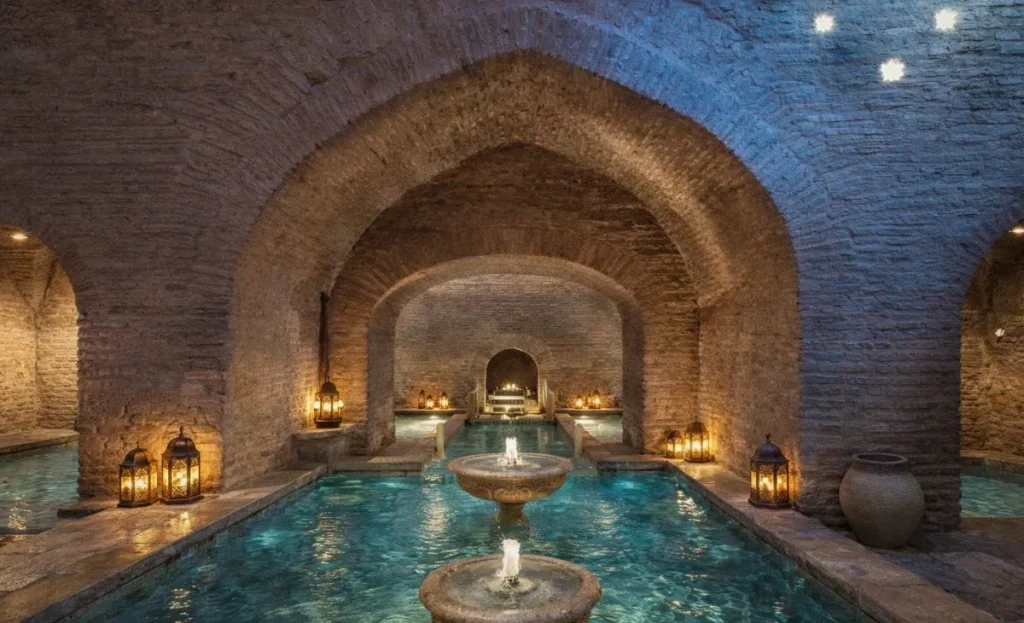
If you are looking for Arab baths in Seville, you have two very different options. On the one hand, the spas that recreate the Arab aesthetic with tiles, arches and water at different temperatures. They are great experiences. On the other hand, a 12th-century hammam that is still standing, with its original vaults intact and its star-shaped oculi looking up to the sky. This guide explains all the options, and at the end we tell you how to combine the two in one day for an experience you won't forget.
The best Arab baths in Seville: a complete guide
Seville has several options for the Arabian bath experience. Here are the three main ones, with everything you need to know before booking.
AIRE Ancient Baths

AIRE is the best known Arab spa in Seville. It occupies an old 16th century Mudejar palace-house in the heart of the Santa Cruz district, just a few metres from the cathedral. Its facilities cover more than 1,200 square metres and include swimming pools at different temperatures, a saltwater bath where you can float like in the Dead Sea, a room with a thousand jets and a rooftop terrace with direct views of the Giralda. The basic circuit lasts an hour and a half. They also offer a wide range of massages and rituals. It is the most complete option for those looking for a long and varied thermal experience.
- Address: Calle Aire, 15, barrio de Santa Cruz
- Profile: Ideal for couples and groups looking for a complete spa experience.
- Web: relax.beaire.com
Thermal baths of Híspalis
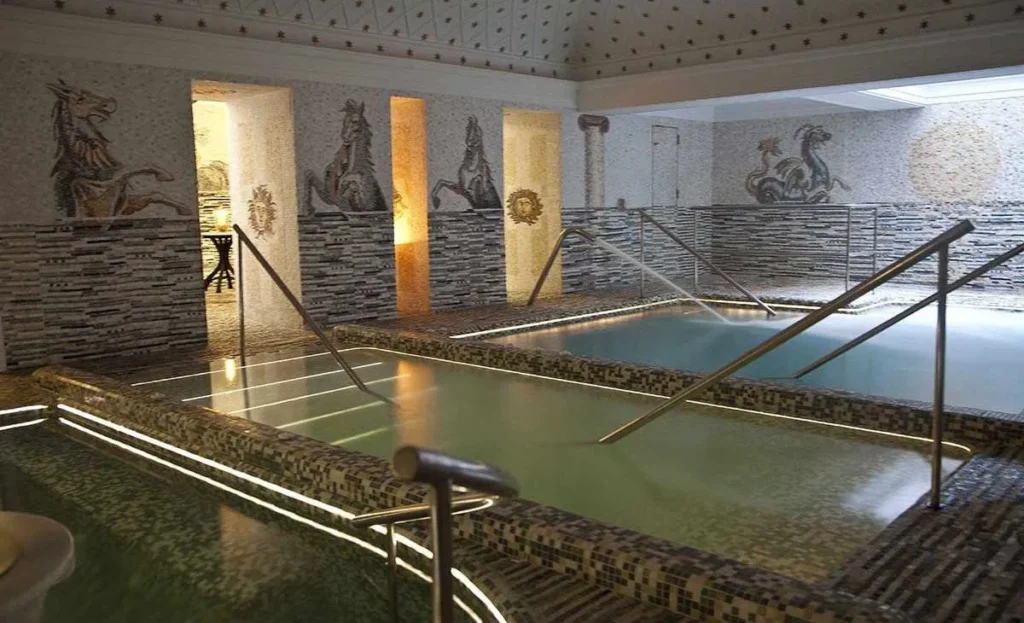
The Termas de Híspalis are the most central option after AIRE. They are located inside the Hotel Las Casas de la Judería, on Calle Santa María la Blanca. The concept pays homage to the ancient Roman baths that served as the basis for the Arab baths. Its facilities include a hydromassage pool, Jacuzzi, frigidarium, Roman thermal bath, Scottish shower and Turkish bath. The basic circuit lasts 90 minutes, with an approximate price of 40 euros per person. At the end, they offer tea or juice with chocolates.
- Address: Calle Santa María la Blanca, 5
- Profile: Ideal for those who prefer a quiet atmosphere in the heart of the historic centre.
- Web: hammamsevilla.com
Medina Aljarafe

Medina Aljarafe is the option for those who prefer to get out of the centre. It is located in Bormujos, about ten minutes from Seville. Its contrasting pools are decorated with Andalusian-inspired tiles and arches, with candles and lanterns that complete the atmosphere. In addition to the thermal circuit, they offer aromatherapy, massages, wraps and steam baths. It is a good alternative if you are looking for more tranquillity and less agglomeration than in the centres of the old town.
- Address: Calle Hernán Cortés, 12, Bormujos
- Profile: Ideal for those who seek peace and quiet and prefer to avoid the hustle and bustle of the city centre.
- Web: https://medinaaljarafe.es/
What is a hammam and how did the Arab bathing ritual work?
To understand why Arab baths are so fascinating, you have to understand what they really were. They were not simply places to wash. They were the social, spiritual and hygienic centre of any Islamic city. In Al-Andalus, every neighbourhood had its own. Seville had dozens of them during the Muslim era.
The water ritual: step by step
The hammam was not a free bath. It was a route with a specific order, inherited from the Roman baths and adapted to Islamic culture. The process always followed the same sequence of three rooms:
- Bayt al-barid (cold room): the entrance. Here the bather undressed, left his clothes and began to acclimatise. It was also the room for rest and conversation after bathing. The equivalent of the Roman frigidarium.
- Bayt al-wastani (warm room): the heart of the hammam. The largest and the one that took up the most time. Most of the visit was spent here, between the gentle warmth of the steam, tea and chatting. The equivalent of the Roman tepidarium.
- Bayt al-sajun (hot room): the most intense. The extreme heat opened the pores and facilitated deep cleansing. Here the kessa, The traditional horsehair glove scrub, and oils and ointments were spread on the skin. The equivalent of the Roman caldarium.
After the tour, the bather would return to the cold room to rest, drink mint tea and stay and chat for hours. The hammam was not a quick visit. It was a social event that could last a whole afternoon.

Religious function: purification before prayer
Islam demands ritual purity before prayer. The hammam fulfilled this function collectively and on a daily basis. That is why they were always built near the mosques. In Seville, the baths in the Santa Cruz neighbourhood were just a few steps from the main mosque, which today is the cathedral. The proximity was no coincidence: it was planned religious architecture.
Muhammad wrote that hygiene is a manifestation of faith. This phrase made the hammam as much a religious institution as a place of daily use. Men and women were not allowed to be in the same shift, so different times were established throughout the day. In some cases, there were separate buildings for each sex.
The hammam as a social space: more than just hygiene
The hammam was also the place where business was transacted, the news of the day was discussed and neighbourhood relations were woven. In a society without cafés or mixed public spaces, the Arab bath was the most important meeting place in the city. Historians describe it as the Islamic equivalent of the Roman forums or the English clubs of the 19th century: a place where everyone went and where everyone met.
In the more upmarket hammams there were also barbers, masseurs and perfume and oil sellers. A full visit could include a shave, an argan oil massage, an exfoliation and several hours of relaxation. It was, in every sense, the original spa.
The architecture of the hammam: why the vaults and star-shaped oculi?
The architecture of the hammam was not decorative. It was functional down to the last detail. The brick vaults collected the steam and distributed it evenly throughout the room. Their hemispherical shape prevented the condensed water from falling directly onto the bathers, directing it instead to the sides.
The star-shaped oculi, known as the madáhuis, were the lighting and ventilation system. They were designed to let in diffused natural light without opening the space to the outside, keeping the heat and humidity inside the room. In many hammams they were covered with coloured glass, creating the effect of warm, subdued light that we recognise today as Arabic aesthetics.
The floor was made of marble or stone, with a hypocaust system: hot water pipes under the floor that heated the room from below. It was the same technique used by the Romans centuries earlier. The Arabs inherited it, refined it and integrated it into a complete sensory experience.
How to prepare to go to the Arab baths in Seville: everything you need to know
If it is your first time in a hammam, it is normal to have doubts. What to wear? How does the circuit go? Do you have to keep quiet? If you have arrived here looking for Arab baths in Seville, these are the answers to the most common questions before the first visit.
What to wear and what not to wear
Most Arab hammams and spas provide a towel, a throwaway bathing costume if you don't bring your own, and non-slip slippers. However, it is advisable to check with each centre before you go. In general:
- Carry: swimming costume, flip-flops if you have them, and long hair tied back. Some centres require this.
- Do not carry: jewellery and metal accessories. Heat and water damage them, and some centres prohibit their use inside the circuit.
- Optional: your own gel or shampoo, although the centres often have products available.
What to expect during the tour
The basic thermal circuit lasts between 90 minutes and two hours. There is no guide to take you from room to room: you set the pace. The usual recommendation is to start in the warm room to acclimatise, move to the hot room when your body is ready, and return to the warm or cold room to recover. The cycle can be repeated as many times as you like during the circuit time.
There is no rush. That is the first unwritten rule of the hammam. The aim is not to complete the tour as quickly as possible, but to let yourself be carried along by the process. Most first-time visitors are surprised at how quickly the two hours pass.
Basic etiquette inside the hammam
The atmosphere of the hammam is one of calm and seclusion. It is not a water park. These are the usual rules of behaviour:
- Speak in a low voice. Silence or quiet conversations are part of the experience. Loud voices break the atmosphere for everyone.
- No mobile phone. Most centres advise against it inside the rooms, both out of respect for others and because the steam damages the devices.
- Hydrate well. The heat makes you sweat a lot. Drinking water before, during and after the circuit is important, especially if you are going to be there for more than an hour.
- Get out if you get dizzy. The combination of heat and humidity can be intense for those who are not used to it. If at any time you feel unwell, go out into the cool room and rest. There is no problem in taking it easy.
Is it worth adding a massage?
If it is your first visit, the thermal circuit alone is a complete experience. There is no need to add a massage to enjoy it. However, if you want to take the experience to the next level, the massage after the circuit is the ideal moment: the muscles are relaxed by the heat and the skin is prepared by the steam. The most recommended for the first time are the argan oil massage and the water ritual, which combines water therapy and massage in the warm pool itself.
The historic hammams of Seville: what is left and what is hidden
Seville was one of the cities with the highest density of hammams in the whole of Al-Andalus. During the Almohad period, in the 12th and 13th centuries, the city had Arab baths scattered throughout its neighbourhoods. Most of them disappeared after the Christian reconquest. However, the city has more remains than meets the eye.
The hammams hidden under the city
One of Seville's best-kept secrets is that several of its most everyday buildings hide hammam structures under their walls. The best known case, apart from San Marco, is that of the Giralda Bar, in Borceguinería Street. During renovation work, the remains of a 12th century Arab bath with Almohad wall paintings were discovered. Today the place is still open as a tapas bar, but its arches and walls are part of an original hammam that nobody expected to find.
There are also remains of Arab baths integrated into the Alcázar of Seville, although they are not independently accessible to the public. The city has been uncovering fragments of its Islamic past in basements, renovations and excavations over the last few centuries. Every time Seville opens up the ground, history appears.
Why did the Arab baths of Seville disappear?
After the reconquest of Seville in 1248 by Ferdinand III, the hammams began to lose their original function. Christian culture did not have the same tradition of collective bathing. Moreover, the Inquisition came to view public baths with suspicion, associating them with Muslim and Jewish religious practices. Too frequent bathing could raise suspicions of being a convert.
Throughout the 15th, 16th and 17th centuries, the Sevillian hammams closed one by one. Some were converted into churches. Others became inns for travellers. Many were simply abandoned and their structures were buried under new buildings. By the 17th century, the Arab baths had virtually disappeared from the city. Or so it was thought, until renovations and excavations revealed that many were simply still there, hidden away.
The perfect plan: hammam during the day, dinner in the original Arabic bath in the evening.
Now that you know the history, the experience takes on a whole new meaning. Seville not only has modern spas that recreate the hammam tradition. It also has an original 12th century hammam where you can dine tonight, with the same vaults, the same star-shaped oculi and the same architecture as 900 years ago.
The best plan in Seville is not to choose between the two. It is to do both. Thermal circuit in the morning, historic dinner in the evening. A full Arabian day, from start to finish, in the Santa Cruz district itself.

San Marco Santa Cruz: dining inside an original 12th century Arab bath.
Restaurante San Marco Santa Cruz is housed in one of the two original 12th century hammams that remain in Seville. The vaults are original, not restored. The madáhuis The roofs are the same as they were 900 years ago. The building is under strict heritage protection. The street where it is located, the Mesón del Moro Street, It has borne this name since the Catholic Monarchs converted these baths into inns for Mudejar merchants in the 13th century.
San Marco has been here for more than 30 years. The cuisine is Italian-Mediterranean, with a tasting menu designed to match the surroundings. From the restaurant rooms there are direct views of the Giralda, the same tower that was a mosque when this hammam was in operation.
Book a table at San Marco Santa Cruz →
Your complete Arab day in Seville
This is the perfect combination for a great day out in Santa Cruz:
- Tomorrow: thermal circuit at AIRE Ancient Baths or Termas de Híspalis, a ten-minute walk from San Marco
- Afternoon: stroll through the Santa Cruz neighbourhood, the Calle del Aire and the Seville's secret passages
- Night: dinner at San Marco Santa Cruz, inside the original 12th century hammam, overlooking the Giralda
A whole day in Moorish Seville, without leaving the same neighbourhood.
Frequently asked questions about the Arab baths in Seville
Are there authentic Arab baths in Seville?
Yes, Seville preserves two original 12th century hammams. One of them is the space occupied by the San Marco Santa Cruz Restaurant, in Calle Mesón del Moro, in the Santa Cruz district. Its vaults and starry oculi are original and are protected as a heritage site.
Is it possible to visit an original hammam in Seville?
Yes, the San Marco Santa Cruz Restaurant is open every day, if you pass by Mesón del Moro street you can go inside, even if there are not many people, you can ask the head waiter and go in to see it, even if you don't have a reservation. Although the most impressive thing is to be able to dine inside, you will enjoy a unique gastronomic experience in Seville and in the world. There are also visible remains at Bar Giralda, in Borceguinería street, where arches and Almohad wall paintings from the 12th century were discovered during a renovation.
How much do Arab baths cost in Seville?
Spas such as AIRE or Termas de Híspalis have basic circuits starting at 35-40 euros per person, lasting approximately 90 minutes. Additional treatments and massages cost extra.
Why did the hammams of Seville disappear?
After the Christian reconquest in the 13th century, the Arab baths gradually lost their original function. The Inquisition associated them with Muslim and Jewish religious practices. By the 17th century they had almost completely disappeared, although several of them were hidden under new constructions with their structures intact.
What is the oldest Arab bath in Seville?
The two original 12th century hammams that remain in Seville are the oldest. One of them is the space where Restaurante San Marco Santa Cruz is located, with original vaults intact and under patrimonial protection.